
The NeoMASTER™ has arrived
Fill out the form below to request information for the NeoMASTER COURSE™.
The Creation of NeoMASTER COURSE:
Told by NeoHERO’s Founder, Lindsay Spurgeon.
Digital Creation by Zac Thomas with Paramedia.
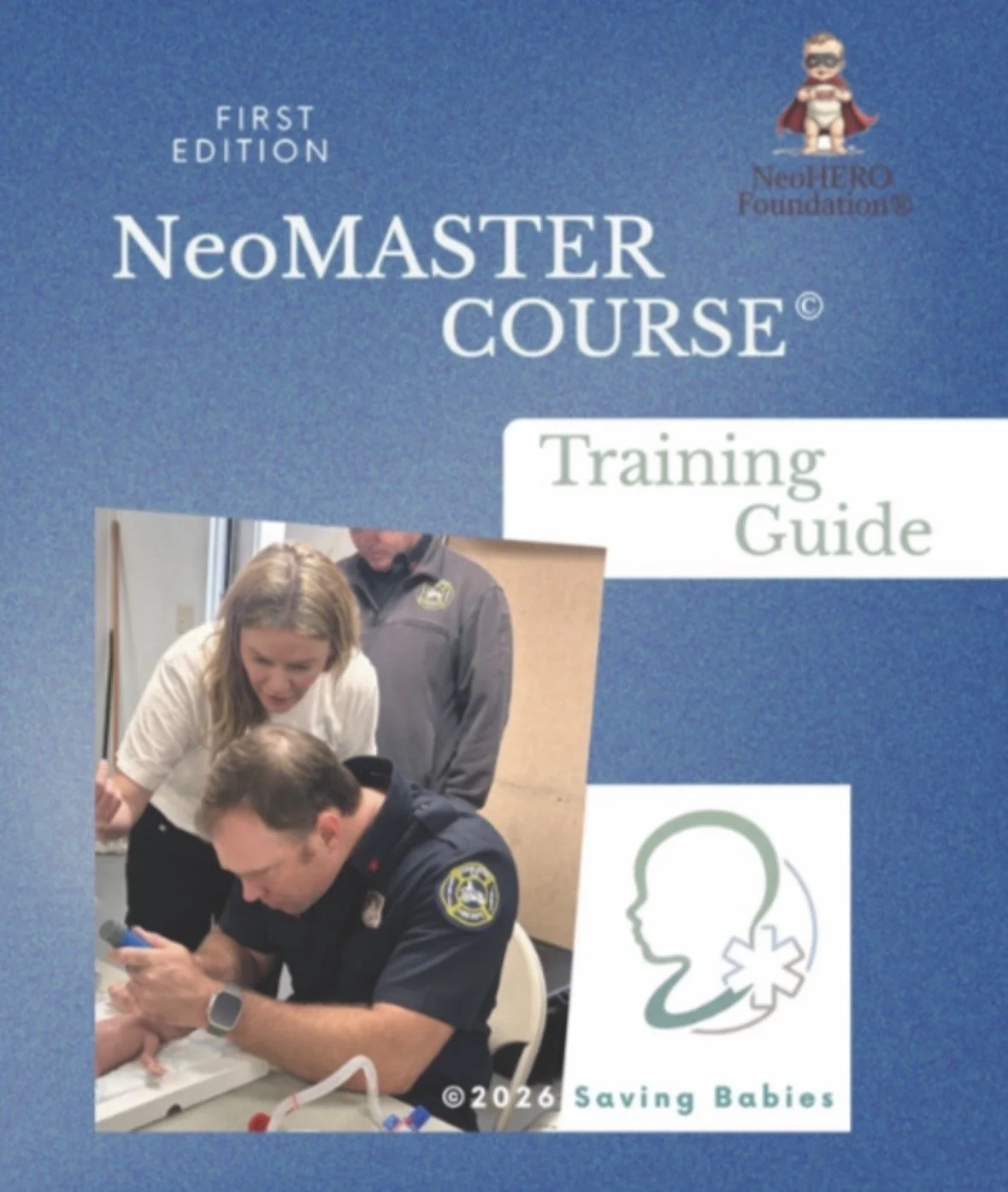
Training Guide Generously Sponsored and Donated by:
NeoHERO’s® Commitment to You:
We designed this course with you, for you.
Instructors will teach engaging, evidence-based ILCOR (International Liaison Committee on Resuscitation) science, hands-on neonatal resuscitation skills for first responders, ensuring that participants gain the skills and confidence needed to provide high-quality neonatal resuscitation in out-of-hospital settings.
We provide hands-on instruction in airway management, ventilation, chest compressions, advanced resuscitation techniques (needle thoracentesis and vascular access), and provide skills stations checklists aligning with NREMT practicals, and transport practice recommendations.
Our program is in-person, hands-on, with no online training and adapts teaching methods for first responders who face different challenges when resuscitating and transporting newborns in out-of-hospital settings.
Our instructors maintain accurate class records and submit documentation in compliance with CAPCE standards and NeoHERO Foundation® policies.
Delivery of e-card within 48 hours of course completion.
We bring the training directly to your department, utilizing your existing classroom facilities. We provide all necessary simulation equipment and learning materials to ensure a comprehensive, hands-on training experience.
The NeoMASTER COURSE™ is a medically directed, evidence-based neonatal training program designed specifically for Fire and EMS professionals, bridging the gap between hospital-based neonatal education and real-world prehospital care. Delivered through both a provider certification pathway and a train-the-trainer instructor pathway, the course emphasizes field-adapted physiology, high-risk scenario performance, transport readiness, and sustainable training capacity, ensuring agencies build both immediate clinical competence and long-term instructional excellence.
Key Highlights
Designed exclusively for the prehospital environment, not just hospital settings
Offers both provider and instructor certification pathways
Focuses on neonatal physiology, stabilization, and transport readiness
Emphasizes thermoregulation, ventilation, and early deterioration recognition
Uses high-fidelity, scenario-based, hands-on training
Medically directed with strict quality control and instructor vetting
Aligns with national standards and evidence-based practice
Builds sustainable in-house training capacity for agencies
Includes structured skills verification and competency assessments
Integrates seamlessly with existing EMS and Fire education programs
Continuing Education Units (CEUs)
The NeoMASTER COURSE™ offers state-approved continuing education for both providers and instructors. The Provider Certification Pathway awards 8 CEUs upon successful completion, the Fundamentals Certifcation Pathway awards 5 CEUs while the Instructor Certification (Train-the-Trainer) Pathway awards 16 or 24 CEUs, depending on the selected format. CEUs are aligned with national standards and meet or exceed state continuing education requirements.
Time Commitment
Provider Certification: 8-hour, in-person course completed in a single day (students for Fundamentals attend the first 5 hours).
Fundamentals Certification: 5-hour, in-person course completed in a single day.
Instructor Certification:
24-hour format delivered over 3 days, or
16-hour format delivered over 2 days.
Both formats include hands-on skills, scenario-based training, and instructor-led evaluations to ensure competency and confidence.
Paramedics as Trainers — A New Opportunity
Paramedics who meet the instructor prerequisites can now become authorized NeoMASTER™ instructors, empowering them to teach neonatal care within their agencies or regions. This creates a powerful pathway for experienced field clinicians to elevate neonatal education, expand training capacity, and directly impact neonatal survival in their communities.